
Zenii
A local AI backend for developers
20 megabytes. AI everywhere.
Install one binary. Every tool on your machine gets AI memory, a shared brain, and a local API. Private. Fast. Extensible.
ChatGPT is a tab you open. Zenii is a capability your machine gains.
Zenii Demo
Why Zenii?
The Problem
You've tried the alternatives. Open Interpreter for code execution. Khoj for document search. Gemini CLI for your terminal. OpenClaw for chat integrations. But none of them is an API server. None gives you 136 routes your scripts can call. None has a native desktop app AND a plugin system in any language AND persistent vector memory AND cron scheduling — all in 20 MB.
No tool that is simultaneously:
- An API server your curl can call (not just a chat interface)
- A native desktop app (not Electron, not a browser tab)
- Extensible in any language (not locked to one ecosystem)
- An AI that remembers and learns (not session-by-session amnesia)
Zenii fills that gap. 20 MB. MIT licensed. Yours.
Built for real desktop AI work
Not a chatbot. An API server.
136 routes. curl http://localhost:18981. Your scripts, cron jobs, and browser extensions all get AI — no SDK required. Interactive docs at /api-docs.
A real desktop app. Not Electron.
Tauri 2 + Svelte 5. Under 20 MB binary. A native app that respects your machine.
Write plugins in Python, Go, JS — or anything.
JSON-RPC 2.0 over stdio. Any language that reads stdin and writes stdout works. Plugins are first-class citizens. A plugin is ~15 lines.
It remembers. Across sessions, across restarts.
SQLite FTS5 + vector search. Conversations, tool results, and context survive restarts. Built-in wiki with stub detection, background lint, and per-page audit. Ask it about last month.
Gets smarter over time. Asks before changing.
Self-evolving agent capabilities with human-approved proposals. The AI learns your preferences and grows its skills — with your permission.
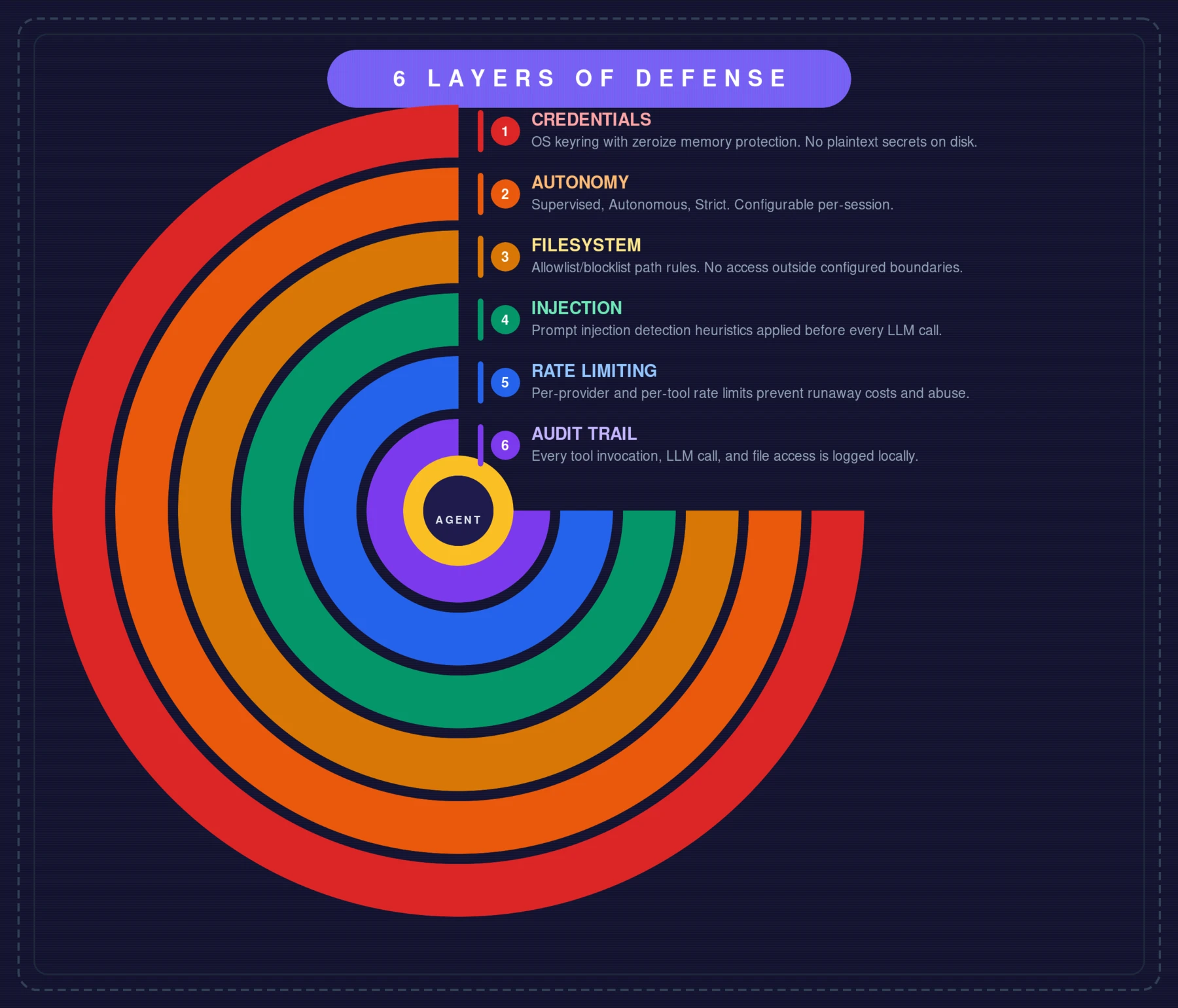
Security is architecture, not a checkbox.
6 layers active by default: OS keyring, autonomy controls, filesystem sandboxing, injection detection, rate limiting, and full audit trail — enforced per interface (CLI, desktop, TUI, MCP, API).
Speaks your language. 7 locales built in.
Interface ships in 7 languages out of the box. CLI, desktop app, and API all follow the same locale setting.
Every tool you use today is an island. Zenii is where they all converge.
Every tool you use today is an island. Zenii is where they all converge.
AI Providers
MCP
Messaging
Dev Tools
Automation
Interfaces
 Zenii
ZeniiWrite a memory from Telegram. Recall it from Python. Schedule a task from the CLI. Get notified on Discord. Everything shares the same brain.
One memory. Four interfaces. Zero configuration.
Desktop app
"Production DB moved to port 5434" — stored to memory
Python deploy script
curl localhost:18981/chat → gets the new port automatically
Telegram
Teammate asks the bot → same answer, same memory
Cron report
Scheduled status report → includes the DB update
One memory. Four interfaces. Zero configuration.
Get started in minutes
- 1Go to the download section above and grab the installer for your platform.
- 2Run the installer (.dmg for macOS, .msi for Windows, .deb/.rpm for Linux).
- 3Launch Zenii from your applications menu.
- 4Configure your first LLM provider in Settings.
- Go to downloads
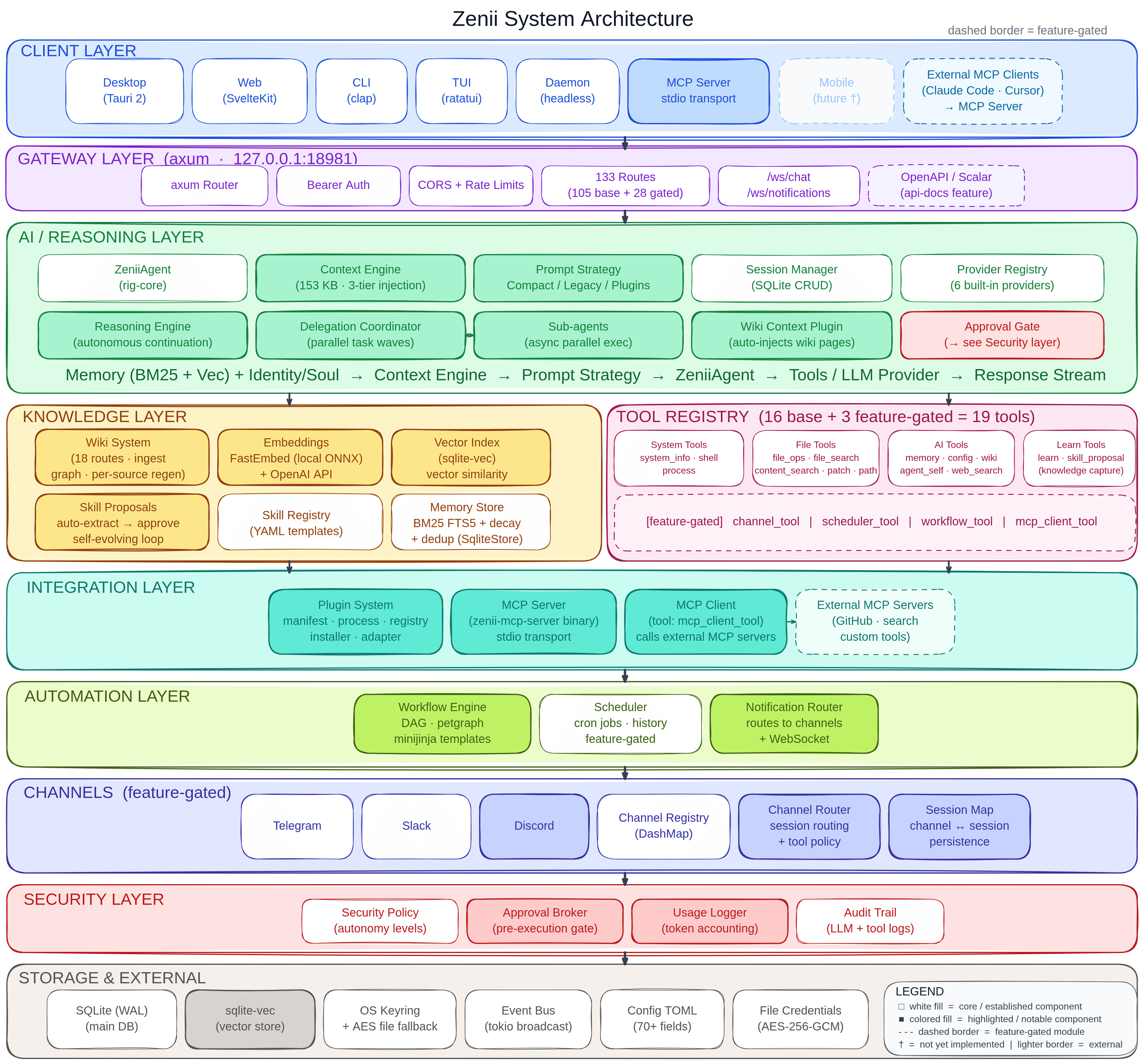
System Architecture
A single 20 MB binary — gateway, core engine, plugin host, and persistent memory — Powered by Rust.
6-layer security defense
Autonomy Modes
Agent operates within tightly constrained boundaries. Minimal autonomy, maximum oversight.
Agent proposes actions. User confirms or rejects each one before execution.
Agent executes autonomously within configured boundaries. Use with caution.
All data stays on your machine. No telemetry, no cloud sync, no account required. Zenii is 0.2.6, actively developed.
Engineering Decisions That Ship
These aren't spec-sheet items. Each is an engineering decision that directly affects your experience.
One brain, five bodies
ALL business logic lives in a single shared core. Desktop, CLI, TUI, and daemon are thin shells. One update improves all four interfaces simultaneously. No feature fragmentation. No "desktop has it but CLI doesn't."
Trait-driven everything
Memory, credentials, AI providers, tools, channels — every major subsystem is behind a Rust trait. Swap the memory backend from SQLite to Postgres. Replace the credential store. Change AI providers. Nothing else needs to change.
Feature-gated lean binary
The default binary ships with the gateway, AI engine, and keyring. Telegram? Discord? Scheduler? API docs? All opt-in via feature flags. You install what you need. The binary doesn't waste a single byte on what you don't.
Hybrid FTS5 + vector scoring
Memory search isn't keyword OR semantic — it's both. Weighted combination of SQLite FTS5 full-text search and sqlite-vec vector embeddings. Memory that understands both what you said and what you meant.
Context auto-discovery
Before every request, Zenii detects which domains are relevant (Channels? Scheduler? Skills? Tools?) and only injects that context into the prompt. Result: ~65% fewer tokens per request than naive "dump everything" approaches. Directly saves you money on API calls.
OS keyring with async fallback
Your API keys live in your OS keyring (macOS Keychain, Windows Credential Manager, Linux Secret Service) — never in a config file, never in a .env. If the keyring isn't available, Zenii falls back gracefully to an in-memory store. Credentials are zeroized from memory when no longer needed.
One codebase. Four interfaces. Zero duplication.
Every binary — desktop app, CLI, TUI, and daemon — is a thin shell over the same shared core. The desktop binary is 67 lines of Rust. The daemon is 74. All business logic, all 136 routes, all 16 tools, all security layers live in one place.
When we add a feature, every interface gets it. When we fix a bug, it's fixed everywhere. This isn't an accident — it's a strict architectural rule enforced since day one.
Your AI gets smarter. You stay in control.
Most AI tools are static — they do exactly what they did on day one. Some self-modify without asking. Zenii takes a third path:
- 1
Zenii observes your patterns and preferences over time
- 2
Zenii proposes skill modifications — "I notice you always want code reviews on Fridays. Want me to schedule that?"
- 3
You approve or reject — like a PR from your AI
- 4
Zenii learns — approved changes become permanent skills
Your AI gets smarter. You stay in control. No surprises.
Where Zenii fits
| Feature | Zenii | OpenClaw | NemoClaw | ZeroClaw | PicoClaw | Open Interpreter | Khoj | Gemini CLI |
|---|---|---|---|---|---|---|---|---|
| Category | AI backend | Chat agent | Enterprise security wrapper | Minimal daemon | Edge AI assistant | Code REPL | Document brain | Terminal AI |
| Language | Rust | TypeScript | TypeScript + Python | Rust | Go | Python | Python/TS | TypeScript |
| Binary | <20 MB (w/ GUI) | ~100 MB+ | Docker container (~500 MB+) | ~3.4 MB | <10 MB RAM | N/A (Python) | N/A (Docker) | N/A (npm) |
| Desktop GUI | Native (Tauri 2) | — | — | — | Web console | — | Browser | — |
| API Routes | 136 REST+WS | Chat endpoint | Inherits OpenClaw | Daemon endpoint | Webhook gateway | — | — | — |
| Plugins | Any language | JS only | Inherits OpenClaw (JS) | Rust only | Tool-based | — | — | — |
| Memory | FTS5 + vectors (machine-wide) | Per-agent SQLite, BM25 + vectors | Inherits OpenClaw (per-agent) | Basic | Workspace logs | — | Doc search | — |
| Self-Evolution | Human-approved | Autonomous | Inherits OpenClaw (sandboxed) | — | Agent-generated | — | — | — |
| Scheduling | Cron + one-shot | Cron | Inherits OpenClaw | — | Built-in | — | Automations | — |
| Offline | Ollama | Ollama | NVIDIA Nemotron primary | Ollama | DuckDuckGo | LiteLLM | Optional | No |
| License | MIT | Open source | Apache 2.0 | Open source | MIT | AGPL-3.0 | AGPL-3.0 | Apache 2.0 |
Code examples
Integrate from any language. No SDK required.
# Health checkcurl http://localhost:18981/health# → {"status": "ok"} # Create a chat sessionSESSION=$(curl -s -X POST http://localhost:18981/sessions \ -H "Content-Type: application/json" \ -d '{"title": "my-project"}' | jq -r '.id') # Send a messagecurl -X POST http://localhost:18981/sessions/$SESSION/messages \ -H "Content-Type: application/json" \ -d '{"role": "user", "content": "What tools do you have available?"}' # Chat with the agent (non-streaming)curl -X POST http://localhost:18981/chat \ -H "Content-Type: application/json" \ -d '{"session_id": "'$SESSION'", "prompt": "Search the web for Rust async patterns"}'Built for how you actually work
Personal Knowledge Assistant
An AI that remembers what you told it last month. FTS5 + vector search means past conversations inform future ones. Your data never leaves your machine.
DevOps Automation Hub
A full API your curl can call — the AI equivalent of a well-documented Unix tool. Built-in cron scheduler — no external orchestration needed.
Private Coding Assistant
Ollama integration for 100% offline operation. An AI that remembers project structure, conventions, and past discussions across restarts.
Multi-Provider AI Router
6 AI providers + any OpenAI API compatible model — one gateway. Switch models per-task without code changes. OS keyring stores all credentials securely.
Plugin Developer Platform
Plugins in any language — Python, Go, JS, whatever you write. JSON-RPC 2.0 over stdio. Their tools appear identically to built-in ones.
Frequently asked questions
General
Zenii (pronounced "ZEN-ee-eye", /ˈzɛn.iː.aɪ/) is a portmanteau of Zen — the Japanese philosophy of calm mastery — and genii, the Latin plural of genius. It’s a local AI backend that gives every tool on your machine access to AI. Install one 20 MB binary, and your scripts have memory, your cron jobs can reason, and your Telegram bot can think. 136 API routes, native desktop app, plugins in any language. Just Rust.
Yes. MIT licensed. Zero subscriptions, zero accounts, zero telemetry. The infrastructure is free. Cloud AI providers (OpenAI, Anthropic, etc.) charge for API usage, but you can go 100% free with Ollama and local models.
Zenii is at 0.2.6 with 1,769+ tests, zero clippy warnings, and 6-layer security. It’s stable for personal and development use.
No. Download a pre-built binary from GitHub Releases or use the install script. Building from source is for contributors.
Linux, macOS, Windows (x86_64), and ARM64 (including Raspberry Pi 4). Pre-built binaries for all platforms.
Comparisons
Complementary. ChatGPT/Claude are conversations that vanish. Zenii is an AI that lives on your machine — remembers what you told it last month, connects to 6 built-in providers (including those same cloud models), and exposes 136 API routes for everything else on your machine to use.
Open Interpreter lets AI run your code. Zenii lets your code run AI. Open Interpreter is a REPL. Zenii is a backend everything on your machine calls — with 136 API routes, persistent memory, plugins, and scheduling. MIT vs AGPL.
Khoj is a brilliant AI second brain for documents. Zenii is programmable AI infrastructure — agent tools, plugin system, cron scheduling, 136 API routes. Khoj searches. Zenii acts. MIT vs AGPL.
Gemini CLI is a terminal tool locked to Google’s models. Zenii supports 6 built-in providers + any OpenAI-compatible endpoint, adds persistent memory, 136 API routes, a native desktop app, plugins, and scheduling.
OpenClaw is an incredible AI you chat with — massive community, 50+ integrations, per-agent SQLite memory. Zenii is AI infrastructure you build on: 136 API routes any script can call, machine-wide memory shared across every interface, native desktop app in 20 MB, plugins in any language. OpenClaw handles chat; Zenii is the backend every tool on your machine calls. They can work together — an OpenClaw agent calling http://localhost:18981 gets Zenii’s cross-interface memory.
ZeroClaw is a 3.4 MB purist's dream — 10ms startup, <5MB RAM, runs on a Raspberry Pi. We share the Rust DNA. Zenii makes a different trade-off: 6x larger (20 MB) but adds a native desktop GUI, machine-wide semantic memory with FTS5 + vector search, 136 API routes, plugins in any language (not just Rust), YAML/TOML workflow DAGs, and a cron scheduler. They're complementary — you can run ZeroClaw as an agent that calls into Zenii's memory backend.
NemoClaw is NVIDIA’s governance layer on top of OpenClaw — policy-based execution, a privacy router, and Nemotron local models for enterprise environments. As of early 2026 it is alpha and not yet recommended for production by NVIDIA. Zenii is independent infrastructure: 136 API routes, native desktop app, machine-wide persistent memory, workflow DAGs, and plugins in any language — all in 20 MB of Rust. MIT licensed; NemoClaw is Apache 2.0 and requires OpenClaw.
Enterprise workflow platforms — heavyweight (Docker + databases). Zenii is a single 20 MB binary for your machine. They orchestrate workflows. Zenii provides the AI reasoning those workflows can call.
Technical
Yes. Pair with Ollama. Zero network calls. Everything in local SQLite.
Any program that speaks JSON-RPC 2.0 over stdin/stdout is a valid plugin. Install from git or local paths. A Python plugin is ~15 lines.
6 built-in: OpenAI, Anthropic (Claude), Google (Gemini), OpenRouter, Ollama, Vercel AI Gateway. Add any OpenAI-compatible endpoint as a custom provider.
SQLite with dual indexing: FTS5 for full-text search and sqlite-vec for vector embeddings. Hybrid scoring combines both at recall time. Persists across sessions and restarts.
Zenii observes your patterns and proposes skill modifications — like a PR from your AI. You approve or reject. Approved changes become permanent. No unauthorized behavior changes.
Single binary deployment. No runtime dependencies. Memory safety without garbage collection. Async done right (tokio). The binary with a full desktop GUI is under 20 MB. Try that with Python, Node.js, or Go + Electron.
HTTP. Any program that can curl http://localhost:18981 can connect — Python, Go, Bash, Node.js, Ruby, or anything else. 136 REST + WebSocket routes, JSON in, JSON out.
Yes. All interfaces share the same memory, same tools, same AI providers, same everything. There’s one brain behind localhost:18981 — it doesn’t matter which door you walk through.
It’s the shared brain behind all of them. Your scripts, bots, cron jobs, and desktop app all connect to the same intelligence. Instead of 5 disconnected AI tools, you have one backend that remembers everything across all of them.
You're early.
Zenii is in active development toward v1.0. Star the repo to follow the journey — early supporters get credited, and your feedback directly shapes the roadmap.
Download Zenii 0.2.6
Choose the right installer for your platform. Your OS has been auto-detected.
Full GUI application with native window
Other formats